
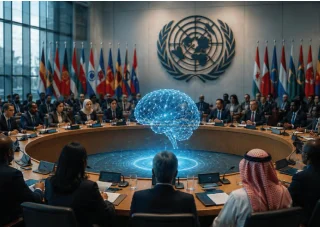
The UN faces a sudden clash between a rapidly advancing technology and slow-moving diplomatic processes. The world’s body for international cooperation is now confronted with artificial intelligence moving far faster than traditional governance can adapt, prompting urgent debates on how to manage risk and ensure safeguards without stalling innovation.
The UN Secretary-General António Guterres has placed a deadline on the table, urging governments to craft within one year a globally inclusive, principles-based framework for managing artificial intelligence risk, underpinned by independent, credible oversight. It is a bold ask from a body accustomed to longer timelines, but one that confronts the real-time pace of AI development.
Even as the UN has not been idle, with the General Assembly creating an Independent International Scientific Panel on AI and a Global Dialogue on AI Governance, and the Secretariat developing further machinery around digital and emerging technologies, critics say more fundamental reform is still needed to keep up with the technology’s velocity.
One observer, reflecting on decades of reform efforts inside and outside the UN, describes the current moment as a mismatch: the group is still arranging the table when it does not yet have a proper kitchen, and the evening crowd is already arriving. The challenge extends beyond AI proper to the horizon of artificial general intelligence, or AGI, which could operate with more autonomy and potentially enhance other AI systems.
The core problem, as noted, is that the international system still uses 20th-century diplomacy to manage a 21st-century technology. Proposals arrive, capitals study them, committees negotiate, drafts circulate, delegations amend, consultations follow, and eventually 193 states reach some form of consensus—if the political weather cooperates. AGI will not wait for such a drawn-out process.
To address this, some propose not just more digital tools, but a concept described as quantum multilateralism: an approach that allows all relevant actors to explore multiple pathways in real time, using open-source processes where ideas, safeguards and institutional arrangements can be tested, challenged and improved continuously.
Fortunately, the path is not entirely uncharted. A notable conduit already exists in the Council of Presidents of the UN General Assembly, known as the UNCPGA. These individuals, chosen by the full UN membership for one-year terms, represent a practical store of knowledge about what 193 sovereign governments can agree on and how to bridge seemingly insurmountable gaps.
Recently, the UNCPGA circulated a document titled “Governance of the Transition to Artificial General Intelligence (AGI): Urgent Considerations for the UN General Assembly.” The work is led by Jerome Glenn, PhD, head of The Millennium Project, which operates as a global participatory futures-research network with 72 nodes linking institutions and individuals across nations and disciplines.
The report elevates the discussion by asking a more challenging question than whether AI should be governed: what if AGI arrives before governance frameworks are in place? It confronts scenarios that have not yet become central to mainstream UN debates, including irreversible loss of meaningful human control, AGI-enabled proliferation of weapons of mass destruction, systemic attacks on critical infrastructure, unprecedented concentrations of power, widening inequality, destabilization of institutions, and the possibility that advanced systems might operate beyond the control of the governments, companies or institutions that created them.
Of particular importance is the possibility that advanced AI systems could function across traditional geopolitical boundaries, rather than remaining within the borders and intentions of any single nation or corporation. This would require a rethinking of diplomacy that moves beyond state-centric models and corporate competition toward shared, enforceable norms and safeguards for a global technology with enormous potential and enormous risk.
Yet the critics and policymakers alike insist the goal is not technological despair but constructive governance. If properly governed, AGI could advance medicine, education, scientific research, economic development and humanity’s ability to address problems currently deemed intractable. The objective should be to harness AGI’s benefits broadly while shielding humanity from unacceptable risks, rather than simply restraining the technology.
The report by the Council stresses moving beyond diagnosis toward concrete institutional architecture, including ideas such as a dedicated General Assembly session on AGI, a global AGI observatory, international safety and reliability certification, a UN convention on AGI and the eventual creation of an international AGI agency. These concepts outline a practical agenda for progress rather than a purely theoretical debate.
Secretary-General Guterres has underscored the urgency, but some argue the UN cannot spend a year merely preparing to begin. The UN General Assembly Presidents’ Council has already laid serious groundwork, effectively inviting the international community to open the kitchen and invite scientists, governments, technology companies, civil society and independent experts to participate. The message is clear: let multiple approaches proceed simultaneously, transparently, and be tested, refined and, if necessary, discarded.
As this debate accelerates, the call is to begin now. The future of AGI, the report implies, does not accommodate delay or missteps in the governance framework. The world must act to ensure a governance system that can keep pace with AGI’s evolution, protecting people and societies while enabling the transformational benefits the technology could deliver.
Hugh Dugan is President of Multilateral Accountability Associates. As a U.S. diplomat, he led reform initiatives and served as senior adviser to 11 U.S. Ambassadors to the United Nations from 1989 to 2015. He later served at the White House as Assistant to the President and Senior Director for International Organization Affairs on the National Security Council.